Talk to us,Get a Solution in 20 minutes
Please let us know any requirements and specific demands,then we work out the solution soonest and send back it for free.
If you’ve ever milled what should be a flat surface and noticed tiny ridges, subtle slopes, or inconsistent depths — even though your CAM looked perfect — you’ve just met tramming error. This is where the spindle isn’t truly perpendicular to the table or fixture, and every cut carries that error into the finished part. Fixing this isn’t just “nice to have” — it’s foundational to reliable machining.
In this post, we’ll talk about probe-assisted tramming — what it is, why you should care, and how probing fundamentally changes how tramming is done compared to old school tools like edge finders or dial indicators.

In machining, tramming means aligning your spindle so it’s truly perpendicular (or orthogonal) to your machine’s axes — especially the table or fixture — so that your cuts come out flat and the toolpath behaves predictably.
Think of a car that needs its wheels aligned: if they’re off by just a tiny bit, the car will drift and wear tires unevenly. On a CNC, if your spindle is off — even by a few thousandths — that drift shows up in your cuts:
That’s why tramming is not a maintenance chore for “some day” — it’s preventative precision.
Explore CNC laser tool setters cnc-probe.
Traditionally, machinists tram using:
These methods can work, but they’re still based on interpretation and physical contact read by a person. That means:
Even after tramming with an indicator, nothing in the machine knows what that alignment looks like as a coordinate — you’ve simply manually made the spindle look straight to your eye.
Check out CNC modular touch probes cnc-probe.
Now, imagine this:
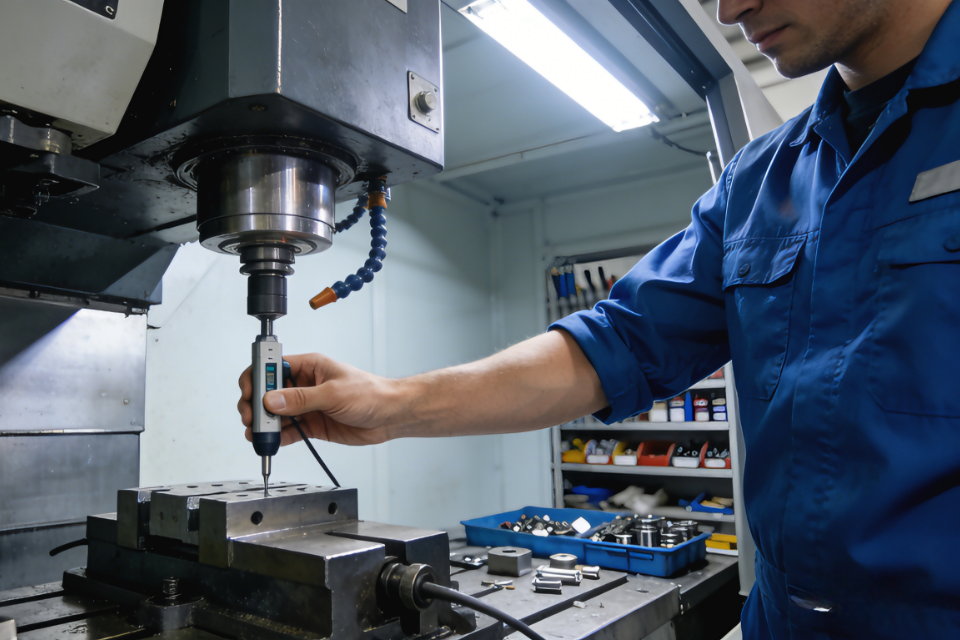
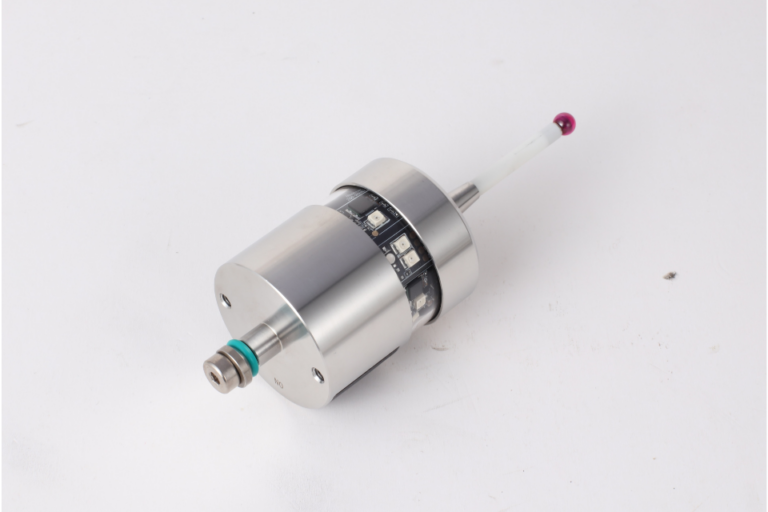
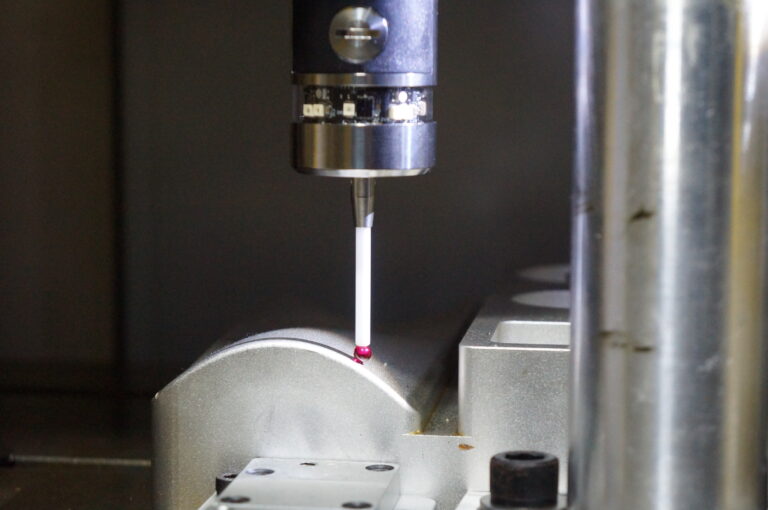
Instead of relying solely on feel or a mechanical indicator bar, your spindle has a CNC probe — a sensor that the controller can read electronically. You program the machine to use the probe to:
That’s what probe-assisted tramming does — it translates geometry into machine logic instead of trusting human interpretation.
Explore CNC Z-axis wired tool setters cnc-probe.

Here’s what happens when you bring probing into tramming:
A probe doesn’t “guess” based on tick marks or tactile feel. It records precise coordinates of contact points and sends them to the controller. That’s repeatable intelligence, not subjective interpretation.
It turns an art into a measurement — and that’s huge.
With probe data stored in the controller’s registers or files, you can compare past alignments to current settings — so you know if the machine drifted over time instead of assuming it didn’t.
Visit CNC Probe homepage cnc-probe.
A practical probe tramming routine loosely follows these steps:
The key difference? The machine is doing the geometry math, not your eyes and hands.
Modern probing cycles in CNC controls — often hidden in probing G/M functions — can handle this automatically when properly configured.
Check out CNC transmission wired touch probes cnc-probe.
Here’s where the deeper truth shows up:
Edge finders and dial indicators give a mechanical cue — you interpret and then enter offsets manually.
A probe gives machine-read coordinate data that becomes part of the control’s geometry understanding.
In traditional methods, after tramming, you trust your setup. In probe-assisted tramming, the controller knows your setup.
That’s the shift from experience-dependent accuracy to data-driven precision.
Explore high-precision measurement CNC probes cnc-probe.

Probe-assisted tramming isn’t just about checking once and forgetting it. It pays off when:
Check out CNC probe products cnc-probe.
Remember that feeling when an indicator bar showed slightly different numbers front vs back on a large surface — and you adjusted, re-checked, and adjusted again? That back-and-forth is what eats time and confidence in setup.
Probe-assisted tramming makes that redundant. It’s like having a “measurement camera” built into your spindle that reads positions, files them, and gives you math-based answers. That certainty improves part quality and frees up your time to think about the next problem instead of re-solving the same old alignment puzzle.
Learn about CNC optical wired five-axis CNC touch tool setters cnc-probe.
Traditional methods like edge finders and dial indicators are tools — good ones when used well. But they depend on human interpretation, muscle memory, and judgment.
By contrast, a CNC probe brings geometry into the digital domain — measurements recorded in machine language, not operator shorthand. That’s why probe-assisted tramming isn’t just a feature or an upgrade — it’s a new mindset about how we align machines in the era of automation and precision manufacturing.
You’re no longer asking the machine, “Does this look square to me?”
You’re telling the machine, “Here are the exact measurements — fix the alignment.”
And that difference? That’s the real edge.