Talk to us,Get a Solution in 20 minutes
Please let us know any requirements and specific demands,then we work out the solution soonest and send back it for free.
Please let us know any requirements and specific demands,then we work out the solution soonest and send back it for free.
Finding the true center of round stock is one of those foundational setup tasks in CNC machining that can quietly wreck a part’s accuracy if done poorly. You might have used edge finders, manual indicators, or traditional center finders — and those tools still have their place. But a modern CNC probe can do this in a way that’s faster, more consistent, and dramatically less dependent on operator feel.
In this blog, we’ll break down why probing routines for center finding matter, how they’re better than old methods, and exactly what’s happening when you use them to find the center of round stock.
If you machine a round part but your center is off, everything downstream suffers:
You might think: “Oh, I’ll just edge find it — that’s close enough.” But if you need repeatability and confidence — especially between shifts or operators — you want a measurement method that talks directly to the CNC controller, not one that relies on human interpretation or manual offsets. Probing does exactly that by recording precise coordinates during contact and using controller logic to compute alignment mathematically.
Learn more about high-precision measurement CNC probes cnc-probe.
Edge and center finders are inexpensive, simple, and familiar:
They’re fine for rough positioning or basic setups, and can be especially useful when you don’t have a probe system installed yet.
But they depend entirely on operator feel and manual calculation — no data gets shared with the controller automatically.
Check out our CNC modular touch probes cnc-probe.
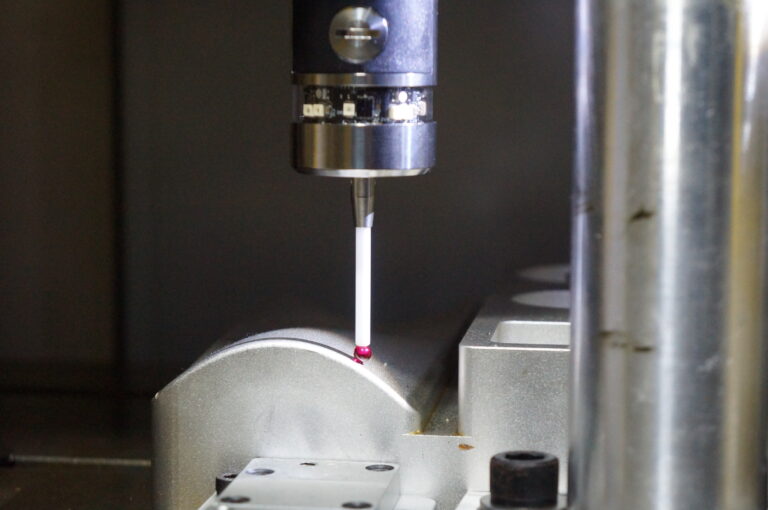
A CNC probe makes contact with the part and sends a precise signal to the machine the instant it touches. This is not just a tactile cue — the controller records exact coordinates and uses them in calculations, automatically. This allows the machine to:
That means setup becomes machine-measured instead of operator-interpreted.
Learn more about CNC laser tool setters cnc-probe.
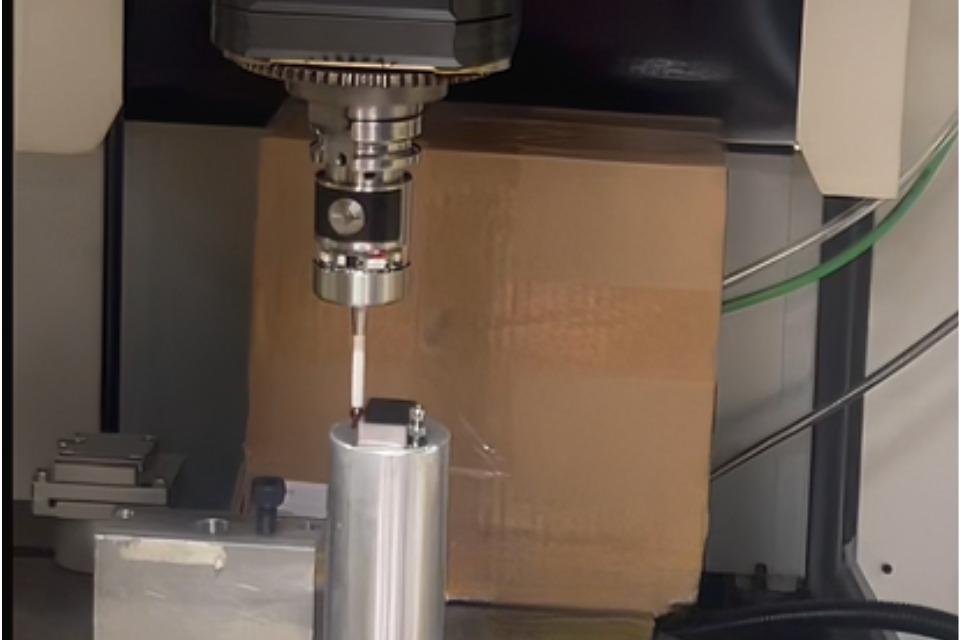
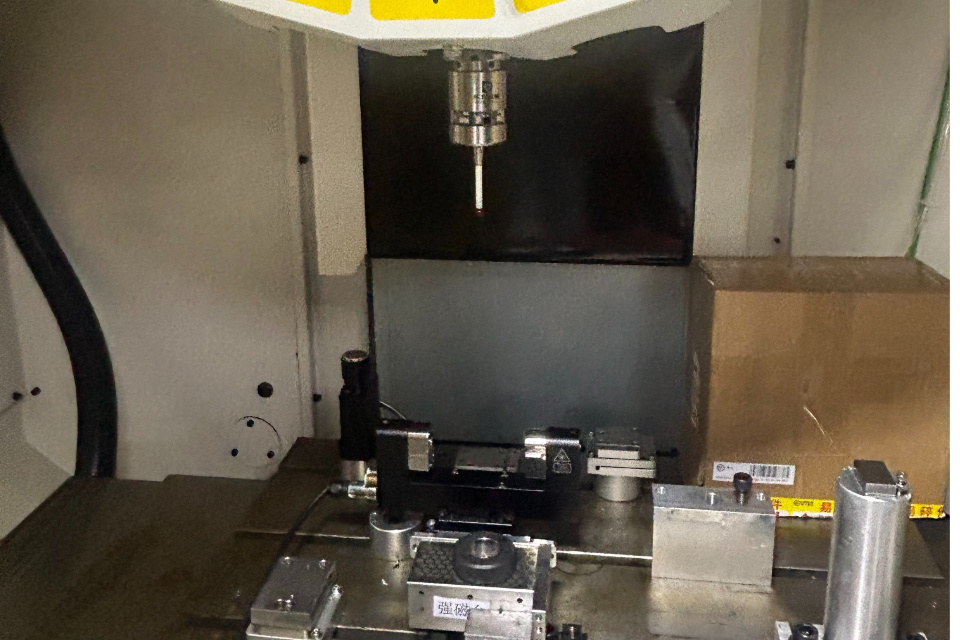
Below is the core logic behind a probing routine to locate the true center of round stock — explained in shop terms so you get what the machine is doing:
You start by defining a rough position for the part on the machine. You don’t need perfect alignment yet — just close enough that probing can reach the surface. Most modern probing systems can handle this because the controller uses probing to set work offsets automatically.
Move the probe so it approaches the round stock from the +X direction.
Slowly feed in until the probe makes contact.
Store the X-coordinate of that contact.
Then:
Once you have both points, the controller can calculate the midpoint between them — which is your true centerline across X. This simple math step is what takes it out of human-dependent calculations.
Repeat the same procedure for Y:
The controller finds the midpoint of those points.
Now you have both X and Y center coordinates calculated directly by the machine.
Discover CNC single-axis wired tool setters cnc-probe.
If your setup includes a rotary table or fixturing that isn’t perfectly square to the axes, sophisticated probing routines (often part of hidden probing G/M macros) can measure deviations and update coordinate systems accordingly. These advanced probing programs eliminate guessing and dramatically reduce setup time.
Visit CNC probe products cnc-probe.
Here’s the cool part that sets probing apart from edge or mechanical center finders:
This reduces setup uncertainty and shop-floor guesswork to nearly zero.
Imagine you run a batch of round parts every day. You could:
Not only is the latter faster — it produces data you can trust, even if someone else runs the machine tomorrow. Accuracy becomes a capability of the process, not a function of the operator.
This is why shop automation isn’t just about plugging in a probe — it’s about using probing routines to guide the machining process with confidence, especially for features that must be concentric or equidistant from center.
Explore CNC transmission wired touch probes cnc-probe.
Here are some real shop insights that go beyond basic manuals:
Learn about high-quality CNC infrared touch probes cnc-probe.
They’re not obsolete. For very quick rough setups — especially in manual mills or when you don’t have a probe — they work fine. But once you have a CNC probe and probing logic in place, probes not only outperform them — they remove the manual interpretation entirely, elevating accuracy and repeatability.
The deeper insight here is this:
Probing routines take setup from being an art to being a reproducible engineering measurement.
That’s the kind of advantage that makes machining more predictable, more profitable, and more confident — not just “faster.”